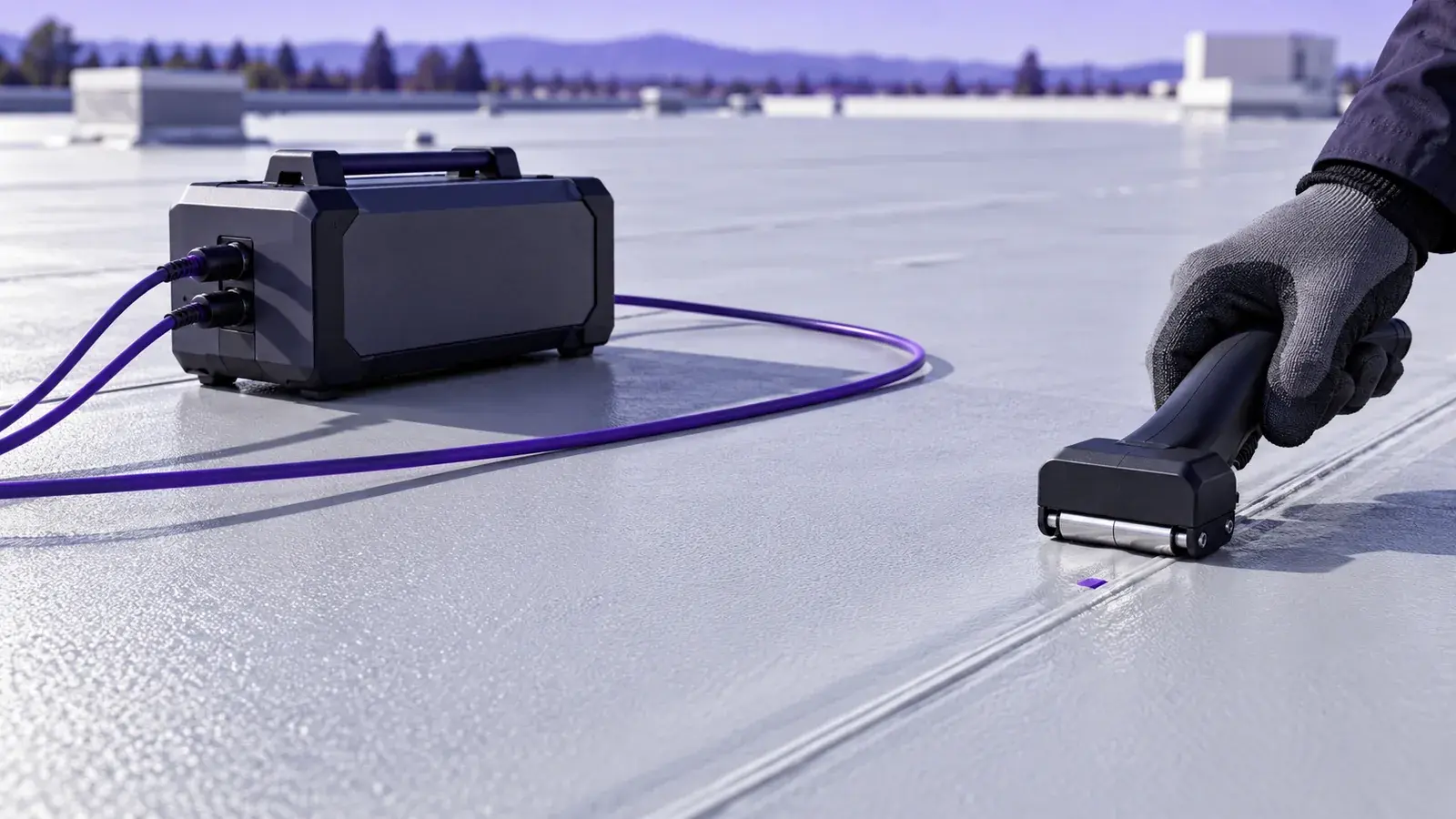
A contractor can photograph a wet ceiling, inspect a drain and still fail to find the membrane breach. That is when an owner may be offered electronic roof leak detection, often called ELD. The choice is not merely between two pieces of equipment. It depends on whether the membrane and underlying assembly can form the electrical conditions a test requires.
The target is a breach, not a moisture map
Infrared moisture surveys and electronic leak detection can serve different stages of the same investigation. The infrared survey flags thermal anomalies that may warrant moisture verification; an appropriate electrical test seeks discontinuities in a compatible waterproofing membrane. When the suspected roof has multiple failure modes, document which question each test is meant to answer before ordering either service.
Electronic leak detection uses an electrical path associated with a discontinuity in a suitable roofing or waterproofing membrane. An infrared moisture survey instead examines thermal patterns that may suggest wet insulation. A roof can have a membrane breach without a large wet-insulation signature, or saturated insulation after an earlier leak with no breach currently detectable by the proposed electrical method.
Decide whether the question is “where is the opening?” or “how much material is wet?” before ordering testing. The infrared roof moisture survey guide covers the second question separately.
Low-voltage methods and what they need
Low-voltage electronic approaches include scanning and vector-mapping techniques, but the test setup and applicable standards are not interchangeable. ASTM D8231 describes one low-voltage scanning practice for detecting and locating membrane breaches under defined conditions. Conductivity, suitable membrane composition, deck configuration, tracer layers and surface wetting may determine feasibility.
On some roofs, the provider can create an appropriate test circuit; on others, hidden nonconductive layers or unsuitable surfaces may prevent reliable interpretation. Ask the vendor to document assembly compatibility before mobilization and identify the precise test method rather than promising that “ELD works everywhere.”
High-voltage methods and surface condition
High-voltage dry testing is another specialized approach for compatible exposed membranes. It requires appropriate surface condition, equipment setup and trained operators. A wet surface may be unsuitable for the planned dry test. It also does not follow that a system suitable for a low-voltage method is automatically suitable for high voltage.
Personnel should not attempt either method with improvised equipment. Testing can involve safety, access and membrane-damage risks; work belongs to qualified personnel following current standards, manufacturer instructions and a documented method statement.
A sensible construction-quality checkpoint
Imagine a new low-slope roof that will later be covered by pavers. The owner wants a documented integrity test before the membrane becomes difficult to access. The project team should agree on what test applies to that assembly and when testing must occur. Record every located breach, repair, retest result and any areas that could not be examined.
A “pass” without coverage boundaries and the test conditions is a weak closeout document. A more useful record states exactly which roof zones were tested and what the method could detect under those conditions.
How to read a test proposal
Ask five specific questions. What membrane and deck were assumed? Which standard and method will be used? What surface preparation, wetting or drying is required? How will defects be marked and repaired? Will repaired locations be retested? Demand a limitations section for overburden, unusual coatings, penetrations, metal elements and inaccessible zones.
Where contractors provide opposing test recommendations, compare the compatibility reasoning and sample test plan rather than relying on instrument brand. Keep the manufacturer's assembly details in the file.
Tie test results to a roof plan
An ELD report is useful only if another person can locate a marked breach. Identify the property, test zones, roof sections, drain and curb references, grid or coordinates, test date, surface condition, equipment, repair authorization and retest outcome. Use photographs showing the location before and after repair.
CapXos Inspect can keep photos and dictated observations connected with the relevant roof sections. It should be treated as a recordkeeping companion, not as electronic detection equipment. Where follow-up work is needed, Takeoff can help record affected areas and quantities.
Overburden changes what can be tested
Vegetated roofs, pavers and ballast introduce very different access conditions. Some test systems are designed for particular covered assemblies, while other procedures require an exposed membrane. Do not infer compatibility merely from a vendor's claim of detecting pinholes “under anything.” The specification should identify whether testing occurs before covering, after covering or both, and explain the limitations of the chosen method. This is crucial when future access would require removing expensive surface materials.
Frequently asked questions
Can electronic leak detection locate trapped water in insulation?
Not directly. That is a different diagnostic question.
Does ELD work with every roof membrane?
No. Membrane and assembly compatibility must be established first.
Is low voltage always better than high voltage?
No. They suit different conditions and methods.
Is a detected breach always the cause of the interior stain?
Not necessarily; evidence must connect the breach to water entry.
What should happen after a breach is repaired?
Document the work and perform an appropriate retest where specified and feasible.