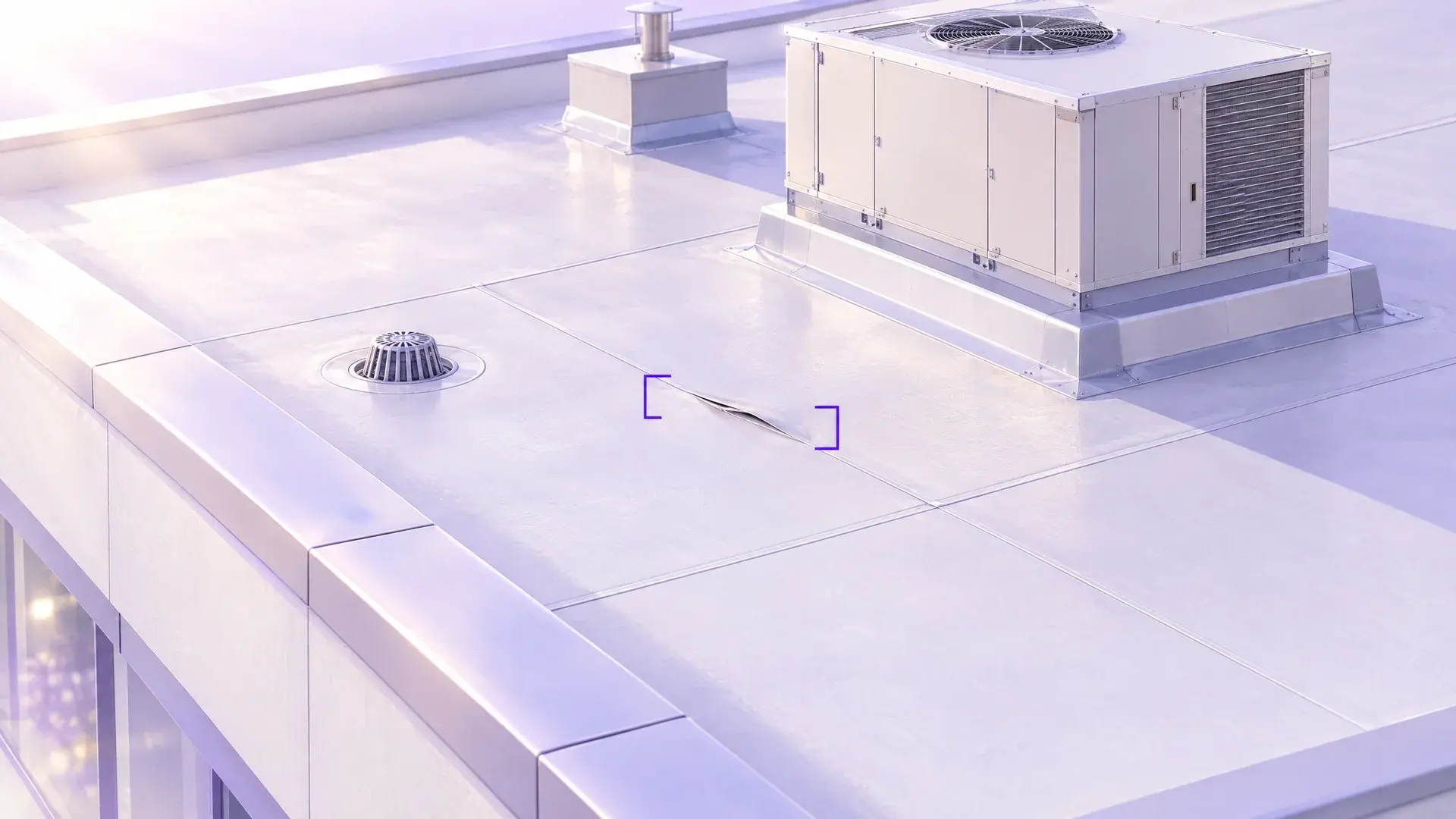
A commercial roof usually gets attention after water reaches the building interior. That is the obvious failure point, but it is not the only time the roof should be evaluated.
The more useful question is what signs justify repair, what can wait for monitoring, and when the condition is serious enough to discuss a larger restoration or replacement project.
Age matters, but it is never the whole answer.
A leak does not automatically mean full replacement
Water inside a building can come from a relatively limited defect:
- an open seam;
- damaged flashing;
- a penetration;
- a puncture in the membrane;
- drainage trouble;
- a failed detail around rooftop equipment.
That is why “the roof leaks” and “the roof must be replaced” are not the same statement.
NRCA training for roof repair and maintenance covers visual inspection, leak investigation, moisture surveys, core sampling, emergency repairs, and permanent repairs as separate parts of the diagnostic process.
The scope of work should follow the condition found on the roof, not a rule based only on age.
Signs that deserve a closer look
- repeated leaks in the same area;
- wet ceiling or interior materials;
- damaged or separated membrane;
- open seams;
- failing flashing;
- defects around penetrations;
- ponding water;
- blocked or damaged drainage;
- repeated patches in one section;
- wind-lifted or displaced components;
- hail impact on susceptible materials or metal;
- damaged roof-mounted equipment or supports.
Maintenance history matters as much as calendar age
NRCA’s roof repair and maintenance guidance describes maintenance as one of the most neglected parts of roof management and says it is a major factor in roof-system life and cost after proper installation.
“Roof system maintenance is often the most neglected area.”
That is why a universal rule such as “replace every commercial roof at X years” is weak.
Before using age as a sales argument, ask:
- What roof system is installed?
- When was the current system installed or reroofed?
- Has it been inspected regularly?
- Are there recurring leaks?
- Have repairs been documented?
- Has the property experienced severe weather since the last major work?
- Is the drainage system functioning properly?
What can be checked before an inspection?
Public and commercial data may reveal estimated roof age, roofing permits, building size, ownership, and severe-weather history.
CapXos brings those signals together at the property level. Contractors can review roof type, age, size, history, and other property information before the first inspection, then keep the resulting opportunity tied to the same property.
Contractors can also compare commercial roof data by market before deciding where to focus inspections and outreach.
When is roof repair urgent?
“Urgent roof repair” should be reserved for situations where delay can increase damage or create a safety problem.
- active water intrusion;
- water reaching occupied or sensitive areas;
- damage near electrical systems or valuable inventory;
- open membrane or exposed assembly;
- wind-displaced roof components;
- damage that is still expanding;
- a condition that leaves the building vulnerable to the next rain.
The first priority is then to make the site safe, limit further water entry, document the condition, and determine whether a temporary or permanent repair is appropriate.
What about a roof after hail or high wind?
Severe weather is a reason to inspect, not proof that repair is required.
NOAA and the National Weather Service maintain official records of significant storm events. See the NOAA Storm Events Database. Those records can confirm that hail, damaging wind, or another event affected an area.
But a storm track cannot tell you whether a specific TPO seam opened, an EPDM membrane was punctured, flashing moved, or rooftop equipment caused secondary damage.
For storm-related research, CapXos has a separate guide and state pages that combine weather context with roofing activity.
For weather-related cases, the Storm & Hail Roof Damage Guide adds regional storm context to the property research.
Repair, restoration, or replacement?
A localized repair may make sense when:
- damage is limited;
- the surrounding roof is performing well;
- moisture is not widespread;
- the repair can be completed reliably;
- the same defect is not returning repeatedly.
A broader project becomes more likely when:
- leaks occur in several unrelated areas;
- moisture is widespread;
- repairs are becoming frequent;
- several components are failing at once;
- continued patching no longer makes practical or financial sense.
NRCA’s roof-maintenance guidance treats inspection, repair, re-covering, and replacement as related but separate decisions.
Use the data to start a better conversation
Property data is most useful before the sales call.
Instead of opening with, “Your roof probably needs to be replaced,” a contractor can explain the specific reason the building came up for review: age, permit history, a severe weather event, or a combination of factors.
That gives the owner a reason to consider a condition assessment without turning an estimate into a diagnosis before anyone has inspected the roof.
Check the property in CapXos
Use the CapXos homepage to search an address, city, or ZIP and review the market at no cost. If the property looks worth pursuing, CapXos can keep the roof, contacts, notes, inspection information, proposal, and follow-up in one workflow.
For full platform access, create an account or use the contact form on the homepage to request a demo.
Use CapXos to check a commercial property by address, city, or ZIP and move promising roofs into your pipeline.
Frequently asked questions
What are the most common signs a commercial roof needs repair?
Recurring leaks, membrane damage, open seams, flashing failures, drainage problems, ponding water, and storm-related damage are common reasons for inspection.
Does ponding water mean a commercial roof must be replaced?
Not by itself. Ponding water points to a drainage or slope issue that should be evaluated, but the required fix depends on the roof assembly and whether moisture or material damage has occurred.
How old does a commercial roof have to be before it needs replacement?
There is no single age that applies to every commercial roof. System type, installation, maintenance, weather, drainage, and past repairs all affect service life.
Is a roof inspection needed after hail?
A confirmed hail event can justify an inspection, especially on an older roof or a property with prior problems. The storm record alone cannot confirm damage to a specific building.
Can CapXos tell whether a roof definitely needs repair?
CapXos can surface property, roof, permit, and risk information that helps contractors prioritize buildings. A physical inspection is still required to determine actual condition and scope of work.