
What hail damage looks like on a commercial roof
Hail damage on a commercial roof rarely announces itself. On steep-slope shingles the signs can be easy to miss; on a low-slope commercial system the evidence is subtler still — and it decides whether a roof insurance claim gets paid. On single-ply membranes, fresh impacts show as circular bruises where the hail crushed the insulation or cover board underneath and spatter marks where years of surface grime were knocked clean. On reinforced sheets like TPO and PVC, larger stones can puncture through to the exposed scrim; unreinforced EPDM is more likely to crack or shatter over a hard substrate than expose one. A bruise doesn’t leak the week it happens. It flexes with every thermal cycle afterward, and the membrane opens at that spot months or years later, long after the storm that caused it.
Modified bitumen and built-up roofs tell the story differently: crushed or displaced granules, fractured surfacing, and radiating cracks in the cap sheet. Metal roofing and edge details record the storm as dents — often cosmetic on heavy-gauge panels, but unmistakable on coping, flashing, and the thin fins of rooftop HVAC units. Size matters in predictable ways: hail around one inch (quarter size) can bruise an aged or poorly supported membrane, stones in the 1.5–2-inch range damage healthy membranes and metal, and anything above two inches is a puncture threat to nearly every roof assembly.
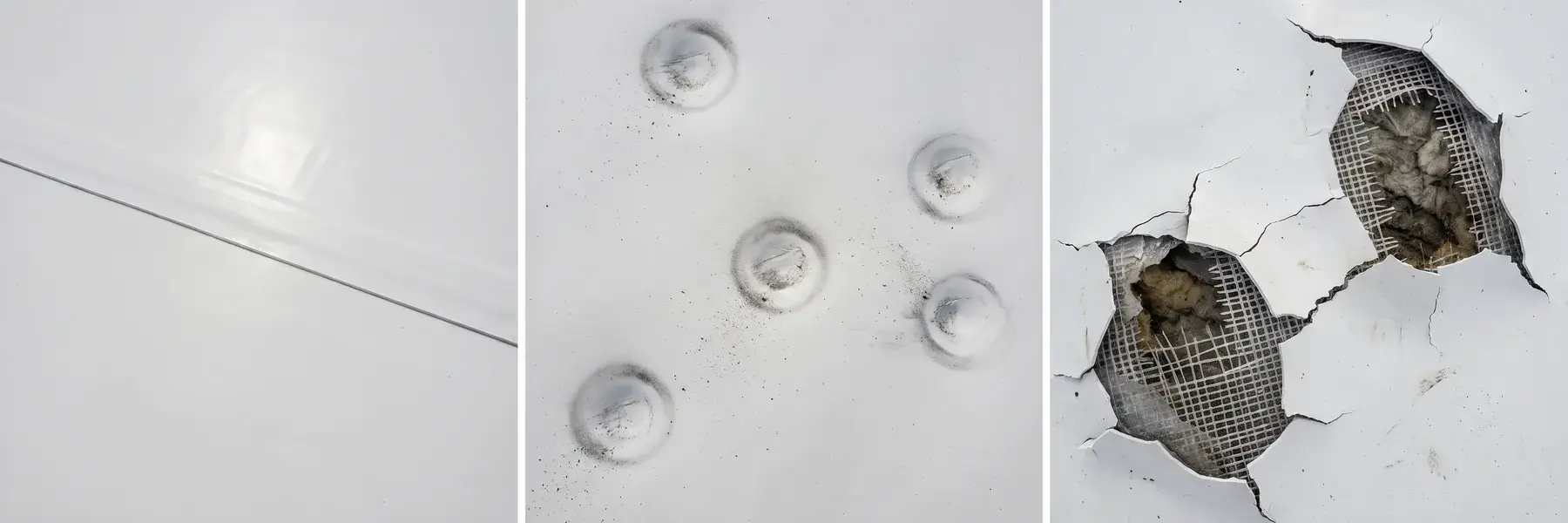
None of this reads from the parking lot. A storm damaged roof can look perfectly normal from the ground while carrying hundreds of bruises across the field of the membrane — which is why a walk-around after the storm is a starting point, not a verdict. Rooftop equipment usually confirms the event first: condenser fins, vent caps, and skylights register hail long before the membrane’s damage becomes visible.
Hail vs. wind vs. storm damage: telling them apart
Hail, wind, and the broader category of storm damage each leave a different signature, and carriers read those signatures closely. Hail is a point-impact peril: strikes scatter in a roughly random pattern across the exposure that faced the storm, similar in size, hitting membrane and equipment alike. Wind damage is structural rather than scattered — it concentrates where uplift pressure peaks, at corners and perimeter edges. Look for creased or tented membrane, seams peeled back in sheets, displaced edge metal and coping, and scoured ballast on ballasted systems. Water intrusion is usually the second act of either: wind-driven rain finds the opening a gust or a hailstone created minutes earlier, then saturates insulation quietly for weeks.
The distinction matters because most commercial policies price these perils differently. Across the Southeast it’s common for wind and hail losses to carry their own deductible — often a percentage of the insured value rather than a flat dollar figure — and losses from a named hurricane can fall under yet another schedule. How the adjuster classifies the damage can change the out-of-pocket number dramatically on a large building.
The perils also travel together. A single supercell can drop two-inch hail and generate straight-line winds within the same hour; a hurricane can bruise nothing yet strip a perimeter clean. An inspection report that separates impact damage from uplift damage — with photos of each — keeps the classification honest and the claim defensible.
The insurance claim process
A storm damage claim moves through predictable stages, and owners who understand the sequence keep control of it. It starts with notice: nearly every policy requires prompt reporting, and prompt means days, not months — late notice is one of the most common reasons otherwise valid claims get contested. The same duty covers mitigation: reasonable temporary repairs (tarps, cleared drains, patched punctures) are expected of the insured, and their cost is generally reimbursable when documented with receipts and photos.
The date of loss then does the heavy lifting. It fixes which policy period responds and which deductible schedule applies. On wind and hail losses across the Southeast, that deductible is frequently a percentage of the insured value — commonly in the 1–5% range — so on a mid-size commercial building the difference between a hail classification and a named-storm classification can be substantial.
The documentation package carries the negotiation. Four items do most of the work: verified weather records placing a damaging event at the address on a specific date; dated photo or drone documentation of the roof; a professional inspection report attributing the damage to storm impact rather than deterioration; and a detailed repair or replacement estimate. Permit history helps too — a documented maintenance record undercuts the “pre-existing wear” argument before it starts.
Expect supplements. The scope approved after the adjuster’s first visit rarely survives contact with the actual tear-off: saturated insulation, damaged decking, and code-required upgrades surface once work begins. Supplements — documented additions to the approved scope — are a normal part of commercial storm claims, not a re-litigation. Keep the paper trail running from the first phone call through the final invoice.
Repair or replace?
Once the damage is documented, the decision comes down to a handful of factors, and age leads the list. Scattered punctures on a roof in the first third of its service life are a repair: patch the impacts, keep the warranty intact, move on. The same impact pattern on a membrane past its midpoint argues for replacement, because every bruise is a future leak, and a patched field of them fails one spot at a time.
Membrane type and availability weigh in next. An older TPO formulation or a discontinued cap sheet may be impossible to match, and a roof that can’t be patched with like material drifts toward replacement — many policies address matching explicitly, so read yours before accepting a patchwork scope. Building codes push the same direction: once storm damage roof repairs cross certain thresholds of roof area, current wind-uplift and energy requirements can apply to the whole assembly, turning a large repair into a replacement by regulation.
Then there’s the market evidence. Roofing permits are public record, and after a major storm they show — county by county — what other owners of storm damaged roofs actually chose. CapXos tracks exactly that: permit volume in the 60 days after each named storm, against the pre-storm baseline — and the state pages below show it storm by storm. When a carrier suggests a patch on a roof the neighbors are replacing, that public record is a useful thing to put on the table. It’s also a scheduling reality check: contractor capacity tightens fast in a post-storm market, and permits show where crews are already committed.