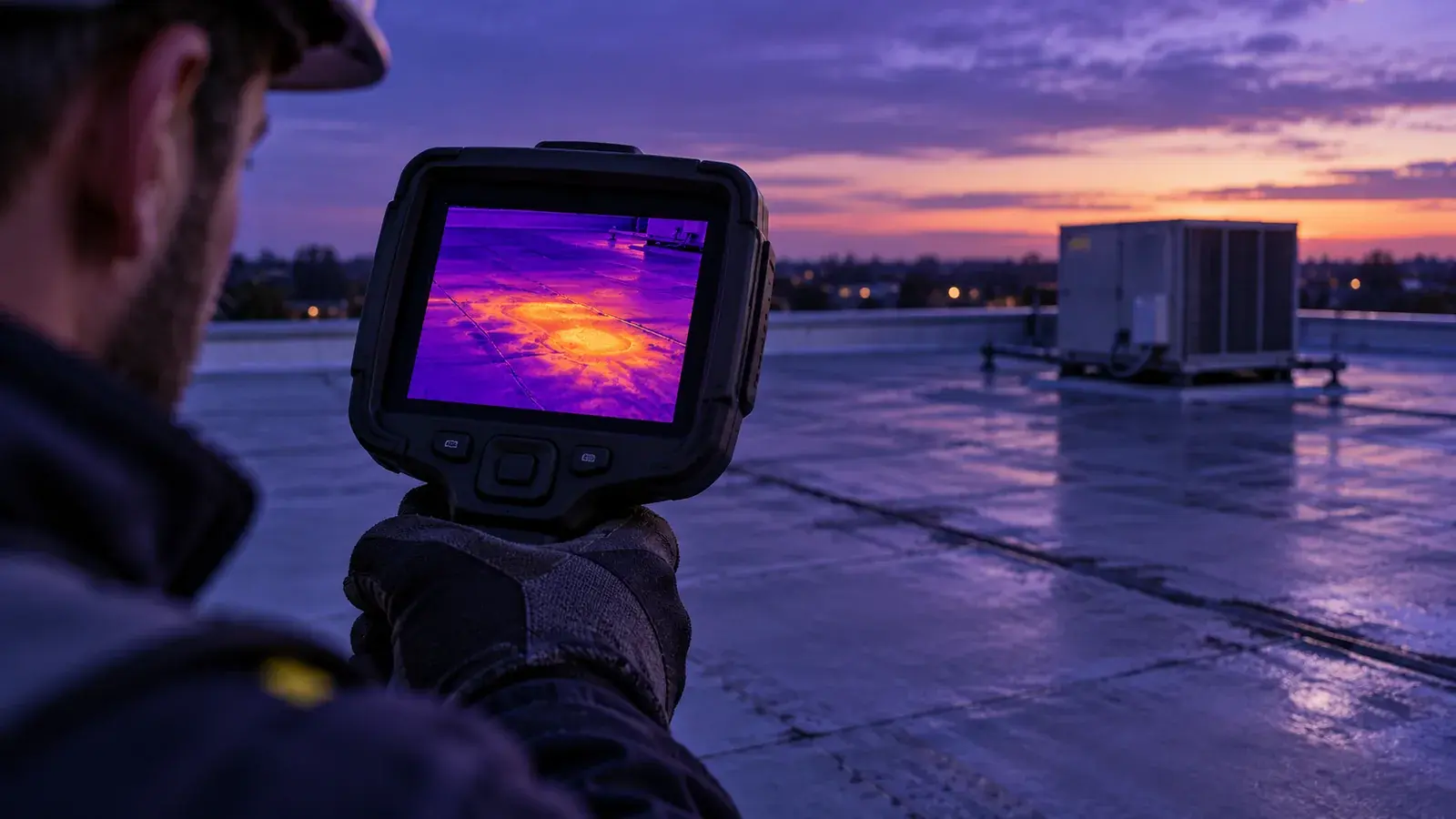
A roof may look dry the morning after a leak while insulation beneath its membrane remains wet. The opposite is also possible: a warm area on an infrared image may have nothing to do with trapped water. The purpose of an infrared commercial roof moisture survey is to locate suspected moisture-related thermal patterns under suitable conditions, then test those patterns before deciding how much work is needed.
What the camera measures
Infrared cameras record emitted thermal radiation and display temperature differences. They do not look through membranes or measure water directly. Under the right construction and weather conditions, wet insulation can cool at a different rate from dry insulation after daytime solar heating. A trained surveyor interprets that contrast alongside the roof assembly, weather history and anomalies that might cause false positives.
ASTM C1153-23 is a relevant U.S. practice for locating wet insulation using infrared imaging. Its scope is specific; it does not determine the source of a leak or declare the roof watertight. That distinction prevents thermal imagery from being sold as a universal roof diagnostic.
Survey conditions determine whether the image means anything
A qualified provider reviews insulation position, roof covering, surface coatings, ballast, recent rain, solar gain, wind, temperature changes and access. Nighttime surveys are common because cooling differences may be easier to detect after sunset. Rain, wind, unexpected reflective surfaces or unusual deck construction can make a survey inconclusive.
Request the operator's intended method and the conditions required before booking a scan. A fixed appointment that proceeds regardless of weather may produce attractive pictures but limited evidence. If the conditions are unsuitable, rescheduling is a quality decision.
The moisture map is a hypothesis until it is verified
Suppose a thermal pass marks three warm regions near rooftop equipment and one large area along a parapet. The surveyor should first rule out obvious equipment heat signatures and construction differences. Then the team can select representative test locations using an appropriate approved verification method, often including physical cores. Record which images correspond to which test results.
Verification is especially important when the findings would change the decision between a localized repair and extensive replacement. The commercial roof replacement budget guide explains how unverified hidden conditions should be treated as scope uncertainty, not as a fixed removal quantity.
What belongs in a defensible report
At minimum the deliverable should identify the inspected address, roof section boundaries, deck and insulation types where known, survey date and weather, camera and survey methodology, image references, anomaly polygons, limitations, verification sites, laboratory findings if any, and recommended next steps. Include a marked roof plan that a repair crew can actually use.
Keep the conclusion proportional. “Thermal anomaly consistent with possible wet insulation; core confirmation pending” is more useful than “roof failed” when no verification has occurred. Similarly, a scan that detects no anomalies under good conditions does not guarantee that no moisture exists anywhere.
Two different owners, two different decisions
A tenant reports one ceiling stain near a drain; a separate owner wants to know whether a proposed restoration can proceed across 60,000 square feet. The first case may begin with targeted leak investigation. The second may justify a systematic moisture survey before coating or budget approval. Neither calls for buying an infrared service solely because it sounds more advanced.
Map the inspection question first: locate a suspected wet field, test restoration suitability, establish a replacement boundary or document change over time. The survey plan should follow that question.
Fit infrared findings into the wider inspection file
The visual commercial roof inspection checklist addresses seams, flashing and visible defects. The infrared report adds a different evidence layer. CapXos Inspect can preserve labeled field photos and observations by section; Takeoff can record the areas associated with proposed repairs. The thermal interpretation and invasive verification remain the responsibilities of qualified surveyors.
Resolve conflicting findings instead of averaging them
If the thermal map and core samples disagree, do not quietly redraw the wet area until the report looks convincing. Review the time of capture, the construction at each anomaly, the core position and whether the survey method applied to that roof. Additional targeted verification may be necessary. Preserve both the original thermograms and revised interpretation; the discrepancy is part of the evidence, especially when an expensive replacement scope depends on it.
Frequently asked questions
Does an infrared scan find the exact leak hole?
No. It can indicate possible wet insulation, but moisture may have moved far from its entry point.
Is infrared roof testing useful during daylight?
Some approaches use different conditions, but the ASTM C1153 practice specifically addresses nighttime infrared methods; follow the selected method.
Are thermal anomalies proof of soaked insulation?
No. They require interpretation and suitable verification.
Can a scan justify an insurance payment?
It may contribute documented evidence; claim and coverage decisions belong to the appropriate parties.
What is the key deliverable?
A reproducible marked roof plan linking anomalies, imagery, test points and verified conclusions.