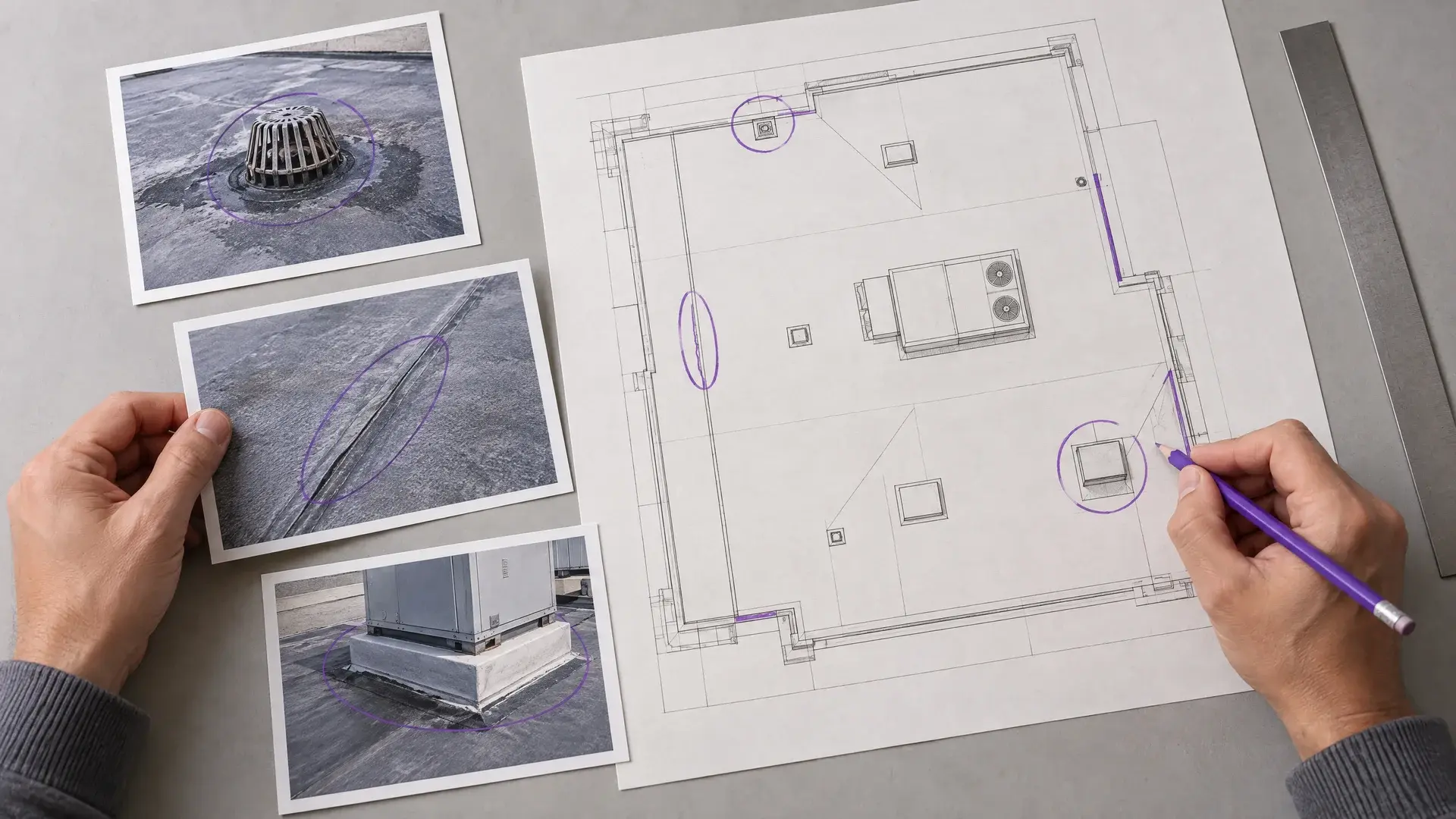
A roof inspection and a roof estimate are not the same document. The inspection records what was found. The estimate turns those findings into scope, quantities, labor and price.
Problems start when the handoff between the two is weak.
A folder of photos, a sketch with no labels and a text message that says "needs 3 curbs flashed" may be enough for the person who was on site. It is not a reliable estimating file for anyone else.
Start with a usable inspection record
Before estimating, the file should answer basic questions:
- Which roof sections were inspected?
- What roof systems are present?
- What defects were observed?
- Where are they located?
- Which findings are confirmed and which are suspected?
- What areas were inaccessible?
- What temporary repairs were completed?
- What still requires testing or owner approval?
NRCA's repair and maintenance training separates visual inspection, leak investigation, moisture surveys and core sampling for a reason. Different methods answer different questions. NRCA's course outline is a useful reference when deciding what the field evidence actually supports.
Convert findings into scope items
Do not price directly from a list of symptoms.
"Leak near RTU" is a finding.
"Remove failed repair at west side of RTU-4, prepare substrate and install compatible flashing repair" is closer to scope.
For each repair item, define location, condition, proposed work, quantity, system assumption and any uncertainty that may change the price.
That structure makes the estimate easier to review and easier to explain to the customer.
Make measurements match the scope
A takeoff should follow the repair or replacement logic, not sit beside it as a separate exercise.
If the scope includes a full reroof, the estimator may need roof area, edge conditions, walls, curbs, penetrations, drains and other system-specific quantities.
If the scope is localized repair, the important numbers may be repair-area dimensions, flashing lengths, curb perimeter, membrane patch sizes or drain work.
CapXos Takeoff records areas, lengths and counts section by section. That means the quantities can stay attached to the same roof sections used during inspection rather than being rebuilt from scratch later. CapXos Inspect and Takeoff are currently free in the web app.
Separate known quantities from allowances
Commercial roofs hide conditions.
Wet insulation, deteriorated decking, multiple roof layers and structural damage may not be fully visible during a non-destructive inspection. A recent commercial roofing discussion described a replacement where tear-off exposed multiple old roof layers plus rotten joists and decking, producing a major change order. It is only one project, but it shows why hidden-condition language matters.
An estimate should distinguish:
Known scope: measured and observed work included in the price.
Allowance: budgeted quantity for something likely but not fully verified.
Unit price: agreed cost for additional quantity if discovered.
Exclusion: work not included and requiring separate authorization.
This is clearer than pretending every concealed condition can be priced from the first walk.
Use photos to support the scope, not decorate the proposal
Inspection photos are most useful when they answer a pricing question: location, surrounding condition, access, previous repairs or a detail that changes scope. If a photo does not help explain the work, it may not belong in the estimating packet.
Flag compatibility questions before pricing
Commercial roof repairs often depend on what material is already installed.
Before finalizing the estimate, confirm the membrane, surfacing, insulation, fastening method, warranty constraints and prior repair materials where possible.
If the existing system cannot be confirmed, include that uncertainty in the scope rather than assuming compatibility.
Build the estimate around decisions the owner can understand
Where appropriate, separate immediate leak repair, corrective work, optional maintenance, a larger replacement alternative and conditions that still require testing. This lets the owner see the short-term decision without hiding the longer-term issue.
Do a final quantity and scope check
Before sending the proposal, compare the estimate back to the inspection. Check that priced repairs match documented findings, roof-section labels match the field record, measurements sit on the right section, and allowances, exclusions, access and staging assumptions are clear.
Speed matters, but so does a clean handoff
In a 2026 discussion among commercial estimators, one roofer described spending roughly three to four hours after takeoff to move quantities through pricing, formatting and quality control, while a more automated internal workflow reduced that specific company's turnaround dramatically. That is anecdotal, not an industry standard, but it highlights where time is often lost: re-entering information between systems. The estimator discussion is useful practical context.
The easiest hours to save are the ones spent reconstructing information that already existed in the field.
Keep the property, inspection and takeoff connected
CapXos is now organized around Analyze, Inspect and Takeoff. A contractor can research the property, capture photos and voice notes on the roof, then organize measurements for the estimate without breaking the property record into separate tools at every step. Open CapXos to start with an address, city or ZIP.
The final estimate may still live in another pricing system, but a connected field record gives the estimator cleaner evidence and quantities.
Frequently asked questions
What information should an inspector give a commercial roofing estimator?
The estimator needs located photos, roof-section names, confirmed conditions, measurements, repair locations, access issues, unknown conditions and any testing or follow-up still required.
Should a commercial roof estimate include hidden damage?
Do not price unknown damage as though it is confirmed. Use allowances, unit prices or exclusions when concealed conditions such as wet insulation, deck damage or extra roof layers cannot be verified before tear-off.
How detailed should a commercial roofing estimate be?
Detailed enough that the customer and production team understand the scope, quantities, assumptions and exclusions. The right level of detail depends on project size and complexity.
What is the difference between a roof inspection report and an estimate?
The inspection report documents conditions. The estimate defines the proposed work and price based on those findings plus measurements, material assumptions and project requirements.
Can CapXos connect inspection findings to takeoff measurements?
Yes. CapXos keeps property, inspection observations and section-based measurements connected through its Analyze, Inspect and Takeoff workflow. Inspect and Takeoff are currently free to use.