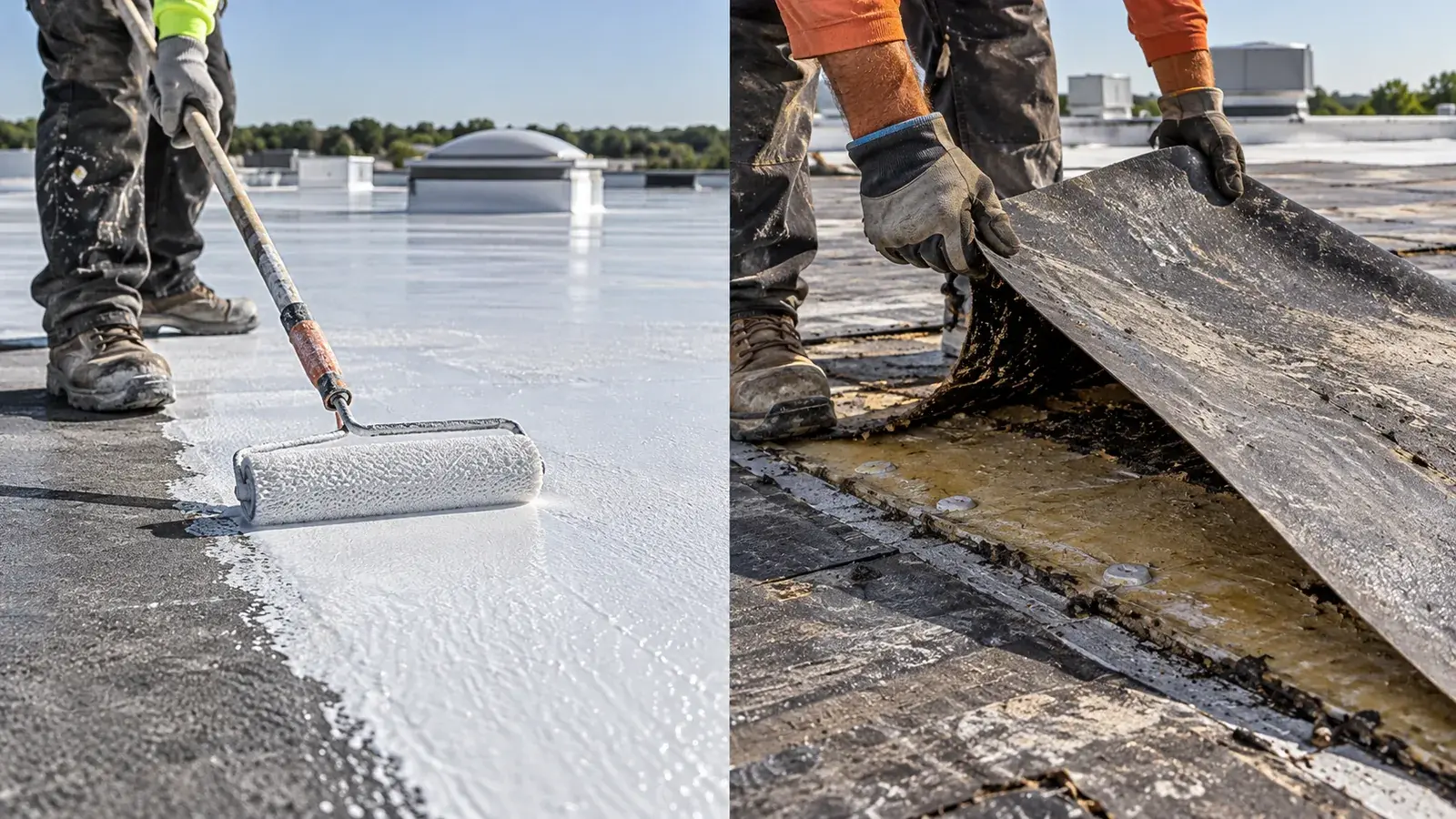
A facilities manager has an aging low-slope roof and needs a realistic scope for next year's budget. One contractor recommends a full tear-off. Another proposes a coating. Both proposals may sound reasonable until somebody checks the existing assembly, moisture conditions and preparation requirements. A commercial roof coating can be appropriate for a serviceable roof, while replacement may be necessary when the underlying system has failed.
Define what is being priced
A coating project typically involves repairs, surface preparation and an approved liquid-applied system over a suitable existing roof. A replacement involves removing or otherwise addressing existing materials and installing a new assembly, with the scope governed by code, structural conditions and project requirements.
First question: Is the underlying roof dry and sound?
Moisture is one of the most consequential variables. Water trapped in insulation or other layers can undermine a coating project and can also affect replacement scope. Look for ongoing leakage, soft areas, damaged decking, recurring ponding and unexplained interior staining.
A qualified inspection may use visual investigation, moisture surveys or selective verification methods appropriate to the assembly. A surface that looks intact in a photograph can conceal wet materials. Likewise, one isolated wet section does not establish that an entire roof must be removed.
GAF's commercial coating-versus-replacement guidance emphasizes structural soundness, moisture, drainage and the condition of the existing system as factors in eligibility.
Check drainage and existing details
Commercial roof coating is sometimes described as a quick way to stop leaks. That description skips the source of the problem. Failed flashing, open seams, poor drainage and deteriorated penetrations may require repairs before an approved coating system can be installed.
Pay particular attention to:
- Roof drains and scuppers, including recurring obstructions.
- Ponding areas and whether the proposed system is approved for those conditions.
- Wall transitions, parapets, curbs, skylights and equipment supports.
- Previously patched areas and material compatibility.
- Rust, surface contamination, adhesion problems and failed older coatings.
- Locations where service crews repeatedly walk or place equipment.
Acrylic, silicone and polyurethane are not interchangeable
Different liquid-applied systems perform differently. Acrylic coatings are commonly selected for appropriate reflective applications. Silicone systems may be considered where their documented water-resistance characteristics fit the site. Polyurethane formulations may be specified where abrasion or traffic resistance matters.
The phrase “silicone roof coating” is not a universal solution for every existing membrane. Substrate compatibility, primers, adhesion testing, preparation, application thickness and warranty eligibility must be checked for the actual product. Some systems have restrictions on where and how they may be recoated later.
Build two comparable scopes
For an owner reviewing roof coating vs replacement, a useful comparison separates the work rather than showing only two prices.
Coating or restoration scope
- Existing assembly and condition assessment.
- Moisture evaluation and areas requiring removal or repair.
- Cleaning, surface preparation and adhesion testing.
- Seam, flashing and penetration reinforcement.
- Primer requirements, coating system and specified application rates.
- Quality-control inspections, exclusions and warranty terms.
Replacement scope
- Tear-off or other code-compliant treatment of existing layers.
- Disposal, access and occupant protection.
- Deck repairs and insulation or cover-board specification.
- New membrane, attachment and wind-uplift requirements.
- Drainage corrections, perimeter details and penetrations.
- Inspection, closeout documents and warranty terms.
Compare costs using the same project scope
Coating often reduces material removal and disruption, but that does not make every coating proposal cheaper. Extensive surface repair, cleaning, safety access, multiple mobilizations or specialized primers can change the economics. On a complex occupied property, scheduling and protection can be major costs for either option.
For a fair comparison, request the same measurement basis, the same known repair areas and clearly separated contingency assumptions. Do not infer costs or quantities from area alone.
Connect the owner's decision to a documented roof
Before the meeting, research the property address, recorded roofing activity and available roof-age information. Public records can help locate prior projects, but an issued permit does not establish that the completed assembly matches the original application.
At the site, record each roof section, photograph exceptions and measure edges, penetrations and areas requiring repairs. CapXos offers free Inspect and Takeoff tools to keep observations and quantities organized. Its commercial roofing map can also support property research before the walk.
Avoid guaranteeing a specific number of additional service years without a project-specific basis. Performance depends on the complete system, installation and maintenance. If the existing roof has a warranty, check restrictions and approval requirements before modifying it.
Frequently asked questions
Is commercial roof coating the same as roof replacement?
No. A coating typically protects a qualifying existing roof after preparation and repairs. A replacement addresses the roofing assembly more extensively, sometimes including removal, insulation and deck work.
Can silicone coating fix a wet commercial roof?
A coating should not be used to conceal wet insulation or structural deterioration. Moisture conditions and the manufacturer's eligibility criteria must be evaluated before work is specified.
What usually makes roof restoration unsuitable?
Significant wet materials, structural problems, unresolved leaks, incompatible substrates and an inability to meet preparation requirements can rule out a proposed restoration system.
How should owners compare coating and replacement prices?
Compare the same measured roof, known repairs, exclusions, system specifications, warranties and operational constraints. A lower headline price without matching scope is misleading.
Can CapXos recommend whether to coat or replace?
CapXos provides property research, inspection documentation and quantity tools. Eligibility and final design require an on-site evaluation and appropriate technical specifications.