A spreadsheet lists a warehouse as built in 1998. An open permit portal shows a roofing permit issued in 2017, and the owner mentions a partial replacement in 2018. Which date belongs in the roof-age column? For a commercial property with multiple roof sections, the answer may be more than one date. Roof age data is useful only when a researcher can show exactly what was dated, by whom, and with what evidence.
Start by defining what “roof age” means
A commercial building may have several roof sections installed at different times. One section might have been replaced after a storm while another has received periodic repairs. A coating application may change maintenance expectations without resetting the installation date of the underlying assembly. Before accepting a roof-age estimate, ask whether it refers to the building, the membrane, the entire assembly or only one roof section.
For a prospecting list, record the newest confirmed installation date and identify which area it covers. If the file cannot distinguish separate sections, label the age as uncertain rather than treating the youngest documented date as the age of every roof on the property.
Read permit descriptions, not just permit dates
Local permit portals are often the most useful starting point because they may describe a replacement, recover, repair or coating project. But a permit issuance date is not proof that the work was completed. Status fields, inspections and closeout dates matter. Search alternate parcel numbers and address formats, especially where a campus contains multiple buildings.
The guide to finding roofing permits by address explains the record-level search. For age verification, the separate question is whether the permitted scope establishes a new roof installation date. “Replace 18,000 square feet of roof” is stronger evidence than “exterior renovation,” while a mechanical-equipment permit may say almost nothing about the roof system.
Reconcile permits with imagery and owner records
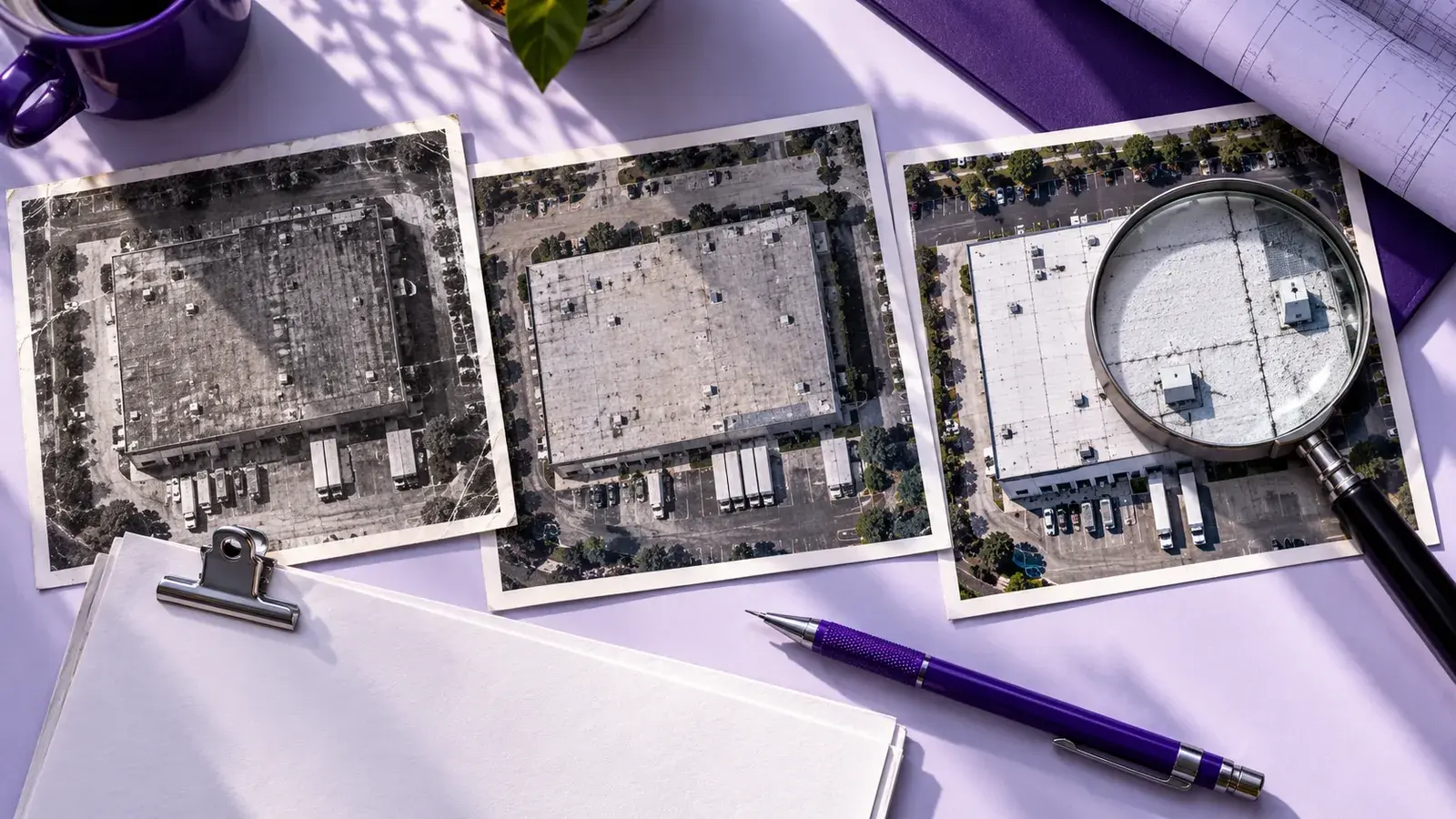
Historical aerial images can sometimes reveal when a roof changed color, layout or visible equipment configuration. Images rarely prove membrane composition or exact installation dates. Assessor records, warranties, prior contractor invoices and facility logs can fill gaps, but each source has limitations. Assessor “effective year built” fields often refer to building improvements, not a roof replacement.
Use at least two independent clues where possible. If an owner provides a 2019 roofing invoice that matches a permit closed in 2020, the discrepancy may simply reflect paperwork timing. Preserve both dates and the document names. Do not silently overwrite one record with the other.
Worked example: a building is not a single roof date
Consider a hypothetical warehouse completed in 1998. Its permit file contains an issued reroof permit from 2017 covering the west wing, a signed invoice dates completion to March 2018, and a 2024 coating invoice covers the main warehouse. The defensible record is: west wing installation, March 2018, verified by invoice; main warehouse membrane installation, unknown; 2024 coating, recorded as maintenance or restoration work rather than a new installation date. The issued 2017 permit stays in the source trail rather than replacing the completion date.
This distinction matters when a contractor needs a section-level inspection plan. A single exported “roof age: eight years” would wrongly make the entire warehouse appear recently reroofed. Preserve the roof-section map and source names so an estimator can question the right area on site.
Build a confidence scale your team can defend
A practical research file uses three tiers. Verified means a dated completion record or owner documentation clearly identifies the relevant roof section. Supported means multiple indirect records agree, such as a permit and visible imagery change. Estimated means the number comes from building age, material appearance or an unverified third-party dataset.
The confidence tier should travel with the age field when a prospect is handed to sales. Otherwise an estimator may repeat “the roof is 25 years old” to a property manager when the database only established that the building was completed 25 years ago. That error damages credibility before an inspection even starts.
Use age as a research signal, not a condition report
Even verified installation age does not establish that a roof needs replacement. System type, drainage, exposure, previous repairs, workmanship and maintenance all influence service life. A ten-year-old roof with persistent ponding may require attention, while an older roof might remain serviceable. Combine age with a review of commercial roof maintenance and repair signs and actual inspection findings.
For commercial prospecting, age is most useful for selecting which records merit deeper investigation. The CapXos commercial roof map can help teams begin with a property and evaluate available signals, but records and coverage vary by location. Confirm critical dates before using them in a customer-facing recommendation.
Maintain an audit trail for every correction
Record address, jurisdiction, parcel number, roof section, source URL, source retrieval date, reported event date, scope, confidence and the person who verified it. Keep previous values when you correct a record so the team can explain why the current number changed. A roof-age spreadsheet without provenance rapidly becomes an expensive collection of assumptions.
When comparing hundreds of commercial properties, create a separate queue for missing or contradictory information. Those records may still be useful, but they should not receive the same certainty as documented replacements. A disciplined approach improves prospect quality and reduces repeat research across sales and field teams.
Frequently asked questions
Can roof age be determined from the year a commercial building was built?
Not reliably. Buildings can be reroofed repeatedly, and different roof sections may have different installation dates. Building age is an initial clue, not proof of current roof age.
Does an issued roofing permit prove the roof was replaced?
No. Check permit status, final inspections, scope and completion documentation. A permit may have been canceled, amended or issued for repairs rather than replacement.
Can satellite imagery show the exact roof installation year?
Usually not. Imagery can narrow a possible change window, but shadows, resolution, weather and surface appearance prevent it from establishing an exact installation date.
What should a roofing contractor do with conflicting roof-age records?
Keep the conflicting dates, trace their sources and mark the record for verification. Do not select the newest or oldest value merely because it supports a sales claim.
How does verified age data help commercial roofing prospecting?
It helps allocate research and inspection time. Combined with permits, weather exposure and owner information, it can identify worthwhile conversations without claiming that any specific roof is defective.