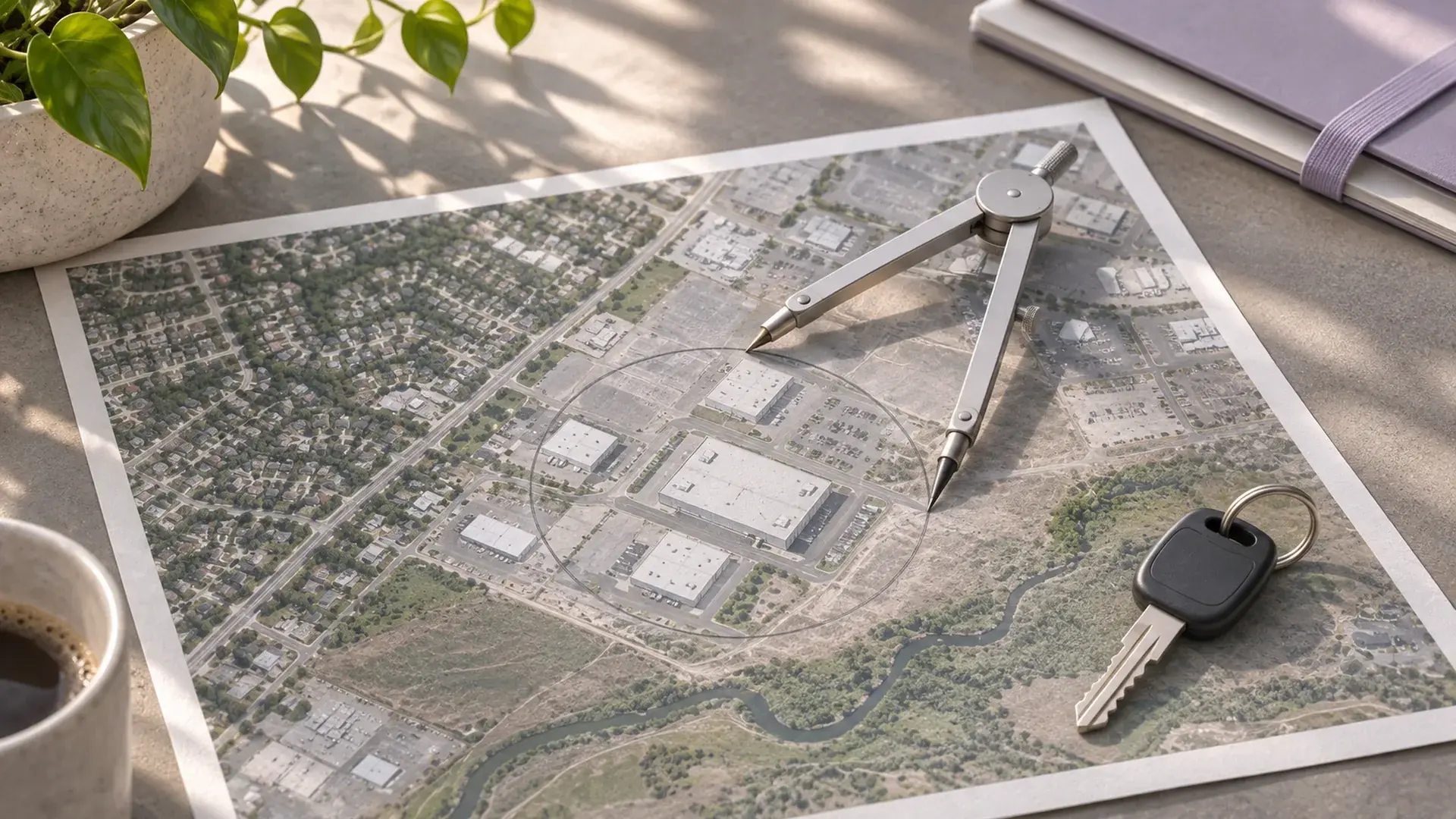
A company that advertises commercial roofing across an entire metro area may only profitably serve part of it. Travel time, traffic, roof access, and the crew's existing route change the economics of each estimate. Search results for commercial roofing leads near me do not solve that problem automatically. A list of addresses can look impressive while sending sales staff across three counties to inspect work the company would never accept.
Define the territory from the crew's calendar
Start with the shop, yard or regular dispatch point, then mark the areas crews can reach without losing a useful part of the day. Driving distance matters more than a perfect circle on a map: a bridge crossing, mountain route or morning traffic corridor may turn a nominal 25-mile prospect into an expensive appointment. Use different service limits for emergency repair, routine inspection, and full replacement. A large reroof may justify a trip that a single-drain repair would not.
Also list the roof systems, heights and site types the team can support. A contractor equipped for low-slope warehouse roofing should not fill the schedule with steep residential-style roofs merely because they are close. Define minimum desirable project scope and any constraints around occupied buildings, medical sites, food operations or special safety procedures. That converts geography into an operational filter.
Work from buildings instead of anonymous lead counts
A commercial roofing territory mapping exercise should begin with actual facilities. Divide the market into manageable zones, then research a limited number of commercial addresses in each. Record building footprint, use, owner or manager where available, and any roof-related records that justify a closer look. Do not present an old permit as evidence that an owner currently wants bids. A record can describe completed work, a planned improvement, or a different trade altogether.
Use the CapXos commercial-roof map at https://capxos.com/ to inspect a few specific ZIP codes, then check whether the selected buildings fall inside actual dispatch routes. Review available roof and permit context to narrow the list. Distance, access and buyer authority still need to be checked separately. This keeps the map useful for territory research without pretending it can calculate a crew's complete operating cost.
Organize routes around the most useful conversations
If an estimator is already visiting a distribution center on Tuesday, nearby industrial and office properties may be sensible follow-up targets. Schedule research before leaving the office. For each candidate, verify whether there is a relevant person to contact and a plausible reason to request an inspection. Avoid dropping unannounced into secured facilities or treating a tenant's front-desk employee as the property decision-maker. An introduction to facilities management is a better outcome than leaving a generic flyer.
A good route mixes confirmed appointments with a small number of researched outreach opportunities. Keep notes about access rules and whether the contact asked for a later call. When an owner is responsible for several properties in the same zone, record the relationship but do not assume that one conversation authorizes visits to every building.
Compare travel cost with possible project value
An address that appears promising can still be a poor use of field time. Estimate the trip, expected inspection hours, access logistics and likely project fit before assigning an estimator. For a modest maintenance job, two long trips may eliminate the margin. For a large replacement project, the company may accept the same drive because staging and labor are already part of a larger plan. Treat these as preliminary business judgments, never as promises of project value based on imagery.
How can I find commercial roofs within 30 miles of my shop? A map radius is a starting filter. The industrial park 24 miles away may be a 25-minute drive, while a downtown site 12 miles away takes 75 minutes in traffic. That distinction matters when dispatching an inspection crew. To decide which nearby buildings could need a roofing contractor, check building type, available roof history, access requirements and the person responsible for maintenance. Keep travel time separate from the evidence supporting each sales approach. A nearby building is worth contacting only when the firm can serve it and has a legitimate reason to introduce itself.
For example, consider two candidate distribution facilities on opposite sides of a metropolitan area. The first is 12 miles away on a highway that routinely backs up during the crew's working hours; the second is 22 miles away but close to an existing service route. A radius filter alone would favor the first. A dispatch review might favor the second for an arranged inspection. Both properties still require independent roof research and permission to visit. Keeping travel planning and property qualification as separate checks prevents a sales list from becoming a collection of technically nearby addresses that are expensive to serve. Apply the same logic to emergency work: published service coverage should match realistic response times, not the farthest point someone can reach on a quiet Sunday morning.
Keep the active territory profitable
Build two small territory lists: one for normal service response and one for planned projects that justify longer travel. Review actual drive times after the first week rather than relying on mileage alone. Use https://capxos.com/ to research commercial roofs in both areas, and request a demonstration if the team wants to assess the property-research workflow before expanding coverage. For authorized site visits, Inspect and Takeoff can support field records.
Frequently asked questions
Is a straight-mile radius enough for roofing lead targeting?
No. Travel time, access restrictions and dispatch location often matter more than the straight-line distance between addresses.
Should the territory include buildings the company cannot service today?
Only in a separate future-opportunity list if the company has a realistic plan to serve them. Keep active prospecting tied to current capabilities.
Can property data confirm that a nearby roof needs replacement?
No. It can inform which buildings merit investigation; a qualified inspection and owner conversation are required for that conclusion.