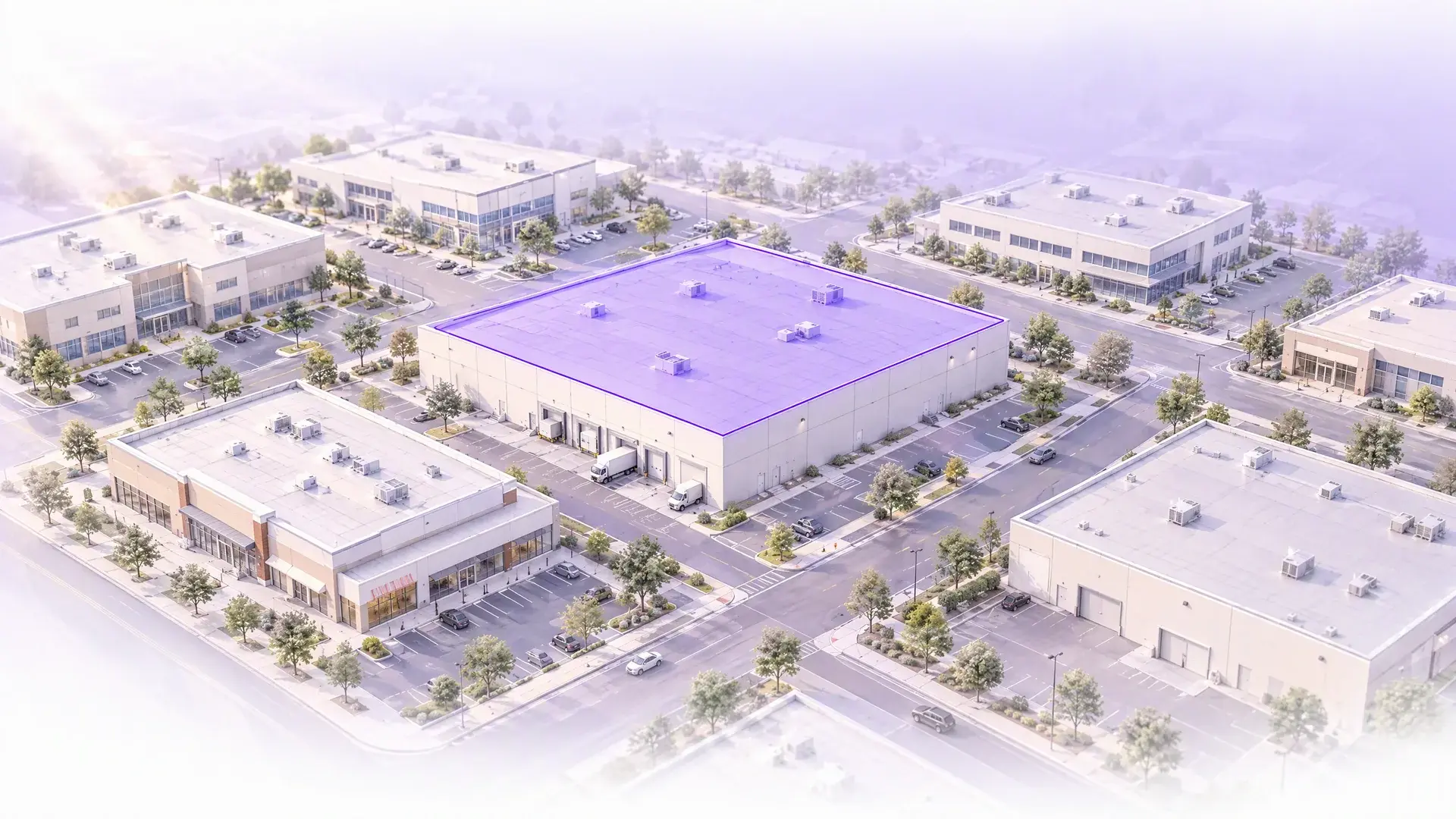
Most commercial roofing leads appear after the owner has already decided to act. By then, the building may be in a bid process, the property manager may have a preferred roofer, and several contractors can be chasing the same job.
A better prospecting question is: which buildings are more likely to need attention soon, and why?
That does not mean guessing that a roof is bad from a map. It means narrowing a large market with several useful signals, then verifying the property before making claims about its condition.
Start with the property, not the phone number
A contact list tells you who can be called. It does not tell you which building is worth calling about.
- roof age or estimated installation period;
- recent and historical roofing permits;
- hail, wind, and hurricane history;
- building type and size;
- ownership and management contacts;
- prior service history, if you already know the property.
CapXos uses this property-first approach. Its commercial roofing pages combine permit activity, roof age, property data, and risk signals so a contractor can start with a roof instead of a generic business list. The commercial roofing hub covers supported metros and is updated weekly.
Contractors can compare permit activity and roof data across CapXos’s commercial roofing markets before deciding which properties deserve a closer look.
Roof age is a filter, not a verdict
An older roof is not automatically a repair job. Two roofs installed in the same year can age differently because of system type, installation quality, drainage, maintenance, foot traffic, climate, and previous repairs.
Age is still useful because prospecting starts with limited time.
If you have thousands of commercial buildings in a territory, it makes sense to rank an older roof with no obvious recent replacement above a roof installed last year. The point is not to declare failure. The point is to decide which property deserves a closer look.
Permit history can show where a roof is in its cycle
Roofing permit data can help establish when major work was permitted and whether the property has seen recent roofing activity.
A fresh reroof permit may actually make a property less interesting for cold prospecting because the project may already be awarded. An older record can be more useful.
Consider a building where:
- the last major roofing permit is many years old;
- the roof is already in an older age band;
- the area has had significant hail or wind since that work;
- no later replacement permit is visible.
None of those facts proves the roof needs repair. Together, they create a reasonable case for prioritizing the property for research, inspection, or outreach.
Permit records also vary by jurisdiction. A missing permit should never be treated as proof that no work occurred.
Add storm history, but do not turn weather into a diagnosis
NOAA's Storm Events Database contains National Weather Service records for significant weather events across the United States. It can be searched by area and event type and currently contains records dating back to 1950.
A hail report near a property does not tell you that a specific membrane, flashing detail, or roof edge was damaged. The roof still needs to be evaluated.
What the event does provide is a reason to move the property higher on the list, especially when the roof is older or its permit history is sparse.
For weather-driven prospecting, CapXos also maintains a Storm & Hail Roof Damage Guide with regional pages for the markets it covers.
One signal is weak. A stack of signals is more useful.
Suppose you are comparing two warehouses.
Property A
- recent roof;
- newer replacement permit;
- no major storm activity after the work.
Property B
- older roof;
- no visible recent reroof permit;
- several severe weather events after the last major roofing record.
Property B is not automatically a lead. It is simply a better candidate for the next step.
A useful next step is to confirm the building and owner, identify the property or facility manager, review storm and permit history, then offer an inspection based on those facts rather than making an unsupported damage claim.
Commercial prospecting is usually a relationship game
Recent discussions among commercial roofers repeatedly point to property managers, facility managers, general contractors, and owners as the contacts that matter.
Contractors also describe a longer sales cycle than in residential work. Relationships may start with a leak call, inspection, or small repair long before a full replacement is approved.
“Commercial is definitely a long game.”
The same pattern appears in recent commercial prospecting discussions among roofers, where contractors describe commercial sales as a longer relationship-driven process rather than a one-call transaction.
A useful commercial lead is not only someone asking for a quote today. It can also be a property with a credible reason for inspection, an identifiable decision-maker, and a logical follow-up date.
Build a short list instead of a giant list
- Choose one metro, ZIP code, or property segment.
- Pull commercial properties that fit your target profile.
- Rank them by age, permit history, and storm exposure.
- Remove obvious recent replacements.
- Identify 20 to 50 properties worth deeper research.
- Find the responsible owner or manager.
- Document why each property made the list.
- Contact them with a property-specific reason.
- Schedule follow-up instead of treating “not now” as a dead lead.
Turn the property into an opportunity in CapXos
CapXos keeps prospecting tied to the actual roof. Contractors can review roof and property information, track an opportunity from inspection through proposal and follow-up, and keep notes, photos, documents, and contacts attached to the property.
Start on the CapXos homepage and search by address, city, or ZIP. The map can currently be browsed without signing up.
If a property is worth pursuing, create an account or use the contact form on the homepage to request a demo and full platform access.
Search by address, city, or ZIP on CapXos to review commercial roofs and decide which properties belong in your pipeline.
Frequently asked questions
What is a commercial roofing lead?
A commercial roofing lead is a potential customer or property connected to a possible roofing project. It may be an active request for work or a building with enough risk signals to justify inspection or outreach.
How can contractors find leads before a bid is posted?
Combine roof age, permit history, severe-weather records, property data, and ownership information to identify buildings worth reviewing before an owner starts a formal bid process.
Does an old roof mean it needs replacement?
No. Age is only one factor. Installation, maintenance, system type, drainage, weather exposure, and previous repairs all affect condition.
Can a hail report prove roof damage?
No. A storm report confirms a weather event in an area, not damage to a specific roof. Storm history is useful for prioritizing inspections.
What does CapXos add to prospecting?
CapXos connects roof and property information with permit activity, risk signals, contacts, and opportunity tracking so contractors can choose which properties to pursue and manage them through the sales process.